 Official website
Ingredient explainer
Magnesium Glycinate Explained: What It Is and Why It Fills the Neuralisse Capsule
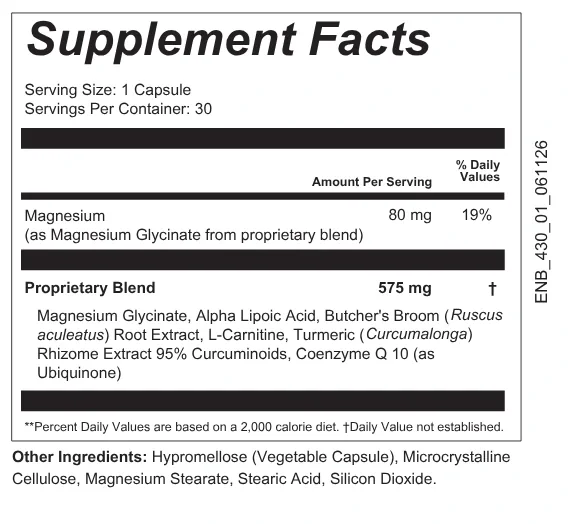
Magnesium glycinate is magnesium bound to the amino acid glycine. Pure bisglycinate is only about 14% magnesium by weight, so the 80 mg of magnesium (19% DV) in each Neuralisse capsule needs about 400 to 567 mg of glycinate. That fills most of the 575 mg blend. The supplement upper limit for adults is 350 mg a day (ODS, Magnesium (HP)).
Written by the Goneuralisse editorial teamUpdated · 8 min read
The mineral
What does magnesium do in the body?
Magnesium is an essential mineral. The NIH says it is important for regulating muscle and nerve function, blood sugar levels and blood pressure (ODS, Magnesium (consumer)).
It also helps build protein, bone and DNA. Your body cannot make it, so it comes from food, water and supplements. Leafy greens, beans, nuts, seeds and whole grains are good sources.
Many adults in the U.S. eat less magnesium than the recommended amount. That gap is one reason magnesium shows up in so many supplements, including Neuralisse, where it is the only ingredient with a printed amount. The magnesium glycinate ingredient page has the short version.
Forms
What forms of magnesium are there?
Supplements never contain magnesium on its own. It is always bound to a partner, and that partner sets the form's name, size and feel in the stomach.
| Form | Bound to | NIH consumer sheet |
|---|---|---|
| Magnesium oxide | Oxygen | Not on the "more easily absorbed" list |
| Magnesium citrate | Citric acid | Listed as more easily absorbed |
| Magnesium chloride | Chloride | Listed as more easily absorbed |
| Magnesium aspartate | Aspartic acid | Listed as more easily absorbed |
| Magnesium lactate | Lactic acid | Listed as more easily absorbed |
| Magnesium glycinate | Glycine (an amino acid) | Not discussed |
Glycinate is a common form that many people choose because it is considered gentle on the stomach. We found no NIH figure showing it is absorbed better than other forms, so we make no claim either way.
Chemistry
How much magnesium is in magnesium glycinate?
Pure magnesium bisglycinate is only about 14% magnesium by weight. One magnesium atom (24.3 g/mol) is bound to two glycine molecules, and the whole compound weighs about 172.4 g/mol.
So 24.3 divided by 172.4 is about 0.14. To get 80 mg of magnesium, you need about 567 mg of pure bisglycinate.
Some suppliers sell "buffered" glycinate, which is mixed with a denser form such as magnesium oxide. Those blends run near 20% magnesium, so 80 mg needs about 400 mg. The Neuralisse label does not say which kind it uses.
Find the share
Pure bisglycinate: 24.3 / 172.4 is about 14% magnesium.
Divide the target
80 mg / 0.14 is about 567 mg of glycinate.
Check the buffered case
80 mg / 0.20 is 400 mg of glycinate.
Daily amounts
How does 80 mg of magnesium compare with daily needs?
The 80 mg in a Neuralisse capsule is 19% of the Daily Value. Adult men need 400 to 420 mg a day from all sources, and adult women need 310 to 320 mg (ODS, Magnesium (HP)).
The upper limit is different. It applies only to magnesium from supplements and medicines, not food, and it is 350 mg a day for adults (ODS, Magnesium (HP)).
| Measure | Amount a day | One capsule's 80 mg |
|---|---|---|
| RDA, men 31+ | 420 mg (all sources) | About 19% |
| RDA, women 31+ | 320 mg (all sources) | 25% |
| Upper limit | 350 mg (supplements only) | About 23% |
If you already take a multivitamin, an antacid or a sleep product with magnesium, add up the supplement amounts. Together they should stay under 350 mg unless your doctor says otherwise.
Give Neuralisse a 60-day trial1 capsule a day · from $49 a bottle · free U.S. shipping on 3 or 6 bottles
Order nowCautions
Who needs to be careful with magnesium supplements?
People with kidney disease need the most care, because weak kidneys cannot clear extra magnesium (ODS, Magnesium (HP)). Too much supplemental magnesium can also cause diarrhea, nausea and cramps.
Magnesium can bind some drugs in the gut. Take osteoporosis drugs called bisphosphonates at least 2 hours apart. Take tetracycline or quinolone antibiotics at least 2 hours before or 4 to 6 hours after magnesium (ODS, Magnesium (HP)). Ask your pharmacist to check your list.
Water pills (loop and thiazide diuretics) make the body lose more magnesium (ODS, Magnesium (HP)). That does not make a supplement right for you, but it is worth raising with your doctor. More drug pairs are on our medicines page.
Blend math
Why does magnesium glycinate fill most of the Neuralisse blend?
Because glycinate is light on magnesium, 80 mg of magnesium takes about 400 to 567 mg of the 575 mg blend. The other five ingredients share what is left, at most about 175 mg in the best case (FDA, Labeling guide ch. IV).
- 575 mg
The whole proprietary blend in one capsule. The label lists six ingredients, heaviest first (FDA, Labeling guide ch. IV).
- 400-567 mg
The 80 mg of magnesium on the label has to come from magnesium glycinate. Pure magnesium bisglycinate is about 14% magnesium (24.3 / 172.4), so it takes about 567 mg. Buffered forms near 20% magnesium take about 400 mg.
- 8-175 mg
What is left for the other five ingredients together. Because they are listed by weight, the second one can be at most half of that, the third a third, and so on.
The most each ingredient can weigh per capsule
- Alpha lipoic acid≤ 175 mg
- Butcher's broom≤ 87 mg
- L-carnitine≤ 58 mg
- Turmeric≤ 43 mg
- Coenzyme Q10≤ 35 mg
Best case: the lighter, 20%-magnesium form of glycinate. If the glycinate is pure bisglycinate, all five share about 8 mg. The label does not say which form is used.
That is why alpha lipoic acid, the second ingredient, can be at most about 175 mg, against 600 mg in most trials. Our alpha lipoic acid research review covers those studies, and the Supplement Facts page shows the full label.
Bottom line
What is the takeaway on magnesium glycinate?
The 80 mg of magnesium is the one solid, printed number on the Neuralisse label: a modest 19% of the Daily Value in a common, gentle form. It also takes up most of the capsule, which leaves little room for the other five ingredients.
FAQ
Magnesium glycinate FAQ
How much magnesium is in Neuralisse?
Each Neuralisse capsule has 80 mg of magnesium, 19% of the Daily Value, from magnesium glycinate in the blend. At one capsule a day, that is 80 mg a day, well under the 350 mg upper limit for magnesium from supplements.
Is magnesium glycinate good for nerves?
Magnesium is important for regulating muscle and nerve function, according to the NIH. No study we found shows glycinate works better for nerves than other forms. Magnesium in any form is not a treatment for neuropathy or nerve damage.
What percentage of magnesium glycinate is magnesium?
Pure magnesium bisglycinate is about 14% magnesium by weight (24.3 / 172.4 g/mol). Buffered glycinate mixed with magnesium oxide runs near 20%. So 80 mg of magnesium takes about 400 to 567 mg of glycinate, depending on the type.
Is magnesium glycinate better absorbed than other forms?
There is no reliable number. The NIH consumer fact sheet lists citrate, chloride, aspartate and lactate as more easily absorbed but does not discuss glycinate. Many people choose glycinate because it is considered gentle, not because of a proven absorption edge.
How much magnesium is too much per day?
For adults, the upper limit for magnesium from supplements and medicines is 350 mg a day. Food magnesium does not count toward it. Going over can cause diarrhea, nausea and cramps, and people with kidney disease face a higher risk of buildup.
Can I take magnesium glycinate with antibiotics?
Space them. Take tetracycline or quinolone antibiotics at least 2 hours before or 4 to 6 hours after magnesium, and keep bisphosphonates at least 2 hours apart. Magnesium can bind these drugs in the gut and lower how much you absorb.
Should people with kidney disease take magnesium supplements?
Only with a doctor's approval. Kidneys clear extra magnesium, so weak kidneys raise the risk of too much magnesium in the blood. Anyone with kidney disease should ask before taking Neuralisse or any product with magnesium.
Who wrote this
Written and reviewed by
A small team that reads the bottle label line by line, checks every number against public health sources (NIH, NCCIH, MSKCC, FDA, FTC, CDC) and rewrites it in plain English. We do not write for the manufacturer, and we update a page whenever the label, the prices or the evidence changes.
Last updated . See our editorial standards and how we check reviews. This website is run by a U.S. authorized merchant, not by the manufacturer. This site is paid a commission when you buy through its order links.
Keep reading
More about Neuralisse
Magnesium glycinate
80 mg of magnesium, 19% DV: what the one printed number in Neuralisse means and how it shapes the blend.
Read more
Medicines and Neuralisse
A medicine-by-medicine interaction table, a daily spacing schedule, and the questions to ask your pharmacist.
Read moreAlpha lipoic acid research
The ALA trials in plain English: what 600 mg did, what it did not do, and how a capsule of Neuralisse compares.
Read moreU.S. authorized Neuralisse merchant
Ready to try Neuralisse?
Pick a pack. At one capsule a day, even the smallest pack covers the full 60-day money-back window.
- Secure checkout
- 60-day money-back guarantee
- Ships from the U.S.